Archaic, Biblical, and Living Forms in the Work of Oleksandr Sukholit
«You are a locked garden, my sister, my bride, a sealed fountain, a well of living water.»
(Song of Songs 4:12)
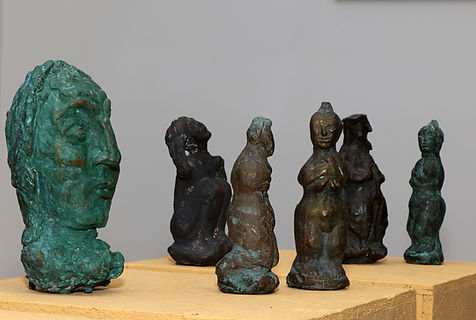
The work of Ukrainian sculptor Oleksandr Sukholit has a special timeless quality. His works seem to stand on the border between different eras: in them, one can recognize echoes of ancient cultures and archaic statues, and at the same time, contemporary artistic thinking. It is this ability to combine the memory of the past with a living sense of the present that makes his plastic art so recognizable.
Sukholit works in a very generalized and restrained manner. His sculptures are devoid of unnecessary details – they are built on simple, balanced silhouettes and soft, flowing lines. This conciseness reflects the influence of archaic art, where form was both simple and symbolic. Biblical images are also present in this plastic art, but not as direct plots – rather as a spiritual mood, as a feeling of primordial harmony between man, earth, and light.
The female image possess a special place in the artist’s work. It appears not as a decorative motif, but as an archetype – a sign of life, birth, and the inner balance of the world. This femininity is expressed very delicately: in the smoothness of forms, in the calm rhythm of the sculpture, in the quiet harmony of the silhouette.
At the same time, small-scale sculptures (statuettes) are an important part of Sukholit’s creative method. It is in these small works that the lively, almost sketch-like nature of his thinking is conveyed at its best. The small form allows the sculptor to work faster and more freely, to capture the impulse, the birth of the image, the first intonation of the form. In such works, the plasticity retains a special freshness and immediacy – as if we see the very moment when the idea appears in the material.
Through this combined language of archaism, biblical symbols, and vivid plastic intuition, Sukholit’s work is perceived as a bridge between different epochs. His sculptures remind us that a simple form can sometimes say more than a complex composition – if it preserves the living energy of the material and the inner silence of the image.